A Roll Through St. Louis with Metro
by Steve Foelsch, Disability Policy Advisor
On the list of things you need to have and do in order to live, learn, work, and play—to fully participate—in your community, what are the must-haves?
Housing? Healthcare? Childcare? Technology? Education? Employment? Transportation? All of these resources are important and interconnected. The web of inputs and dependencies is highly complex, so let’s start with one essential of daily life: transportation.
Life requires transportation.
Transportation is just not getting from point A to point B.
Transportation means independence and freedom of movement. Ever run out to the grocery story when you’re missing an ingredient for dinner? Or opt to drive yourself instead of carpool so you can leave when you want?
Transportation also means being able to interact with your community. Everything from checking out a museum’s new exhibit or catching a baseball game to attending the city council meeting and commenting on issues that matter to you, like what businesses can set up shop in your neighborhood.
Transportation is so much more than getting to your job, or a doctor’s appointment, or your house. In a 2025 federal report surveying the state of accessible transportation, over 70% of people with travel-limiting disabilities limited their day-to-day travel due to barriers. That is a lot of life to be excluded from.
Accessing transportation.
As a quadriplegic and wheelchair user of 40 years, accessible transportation is not only essential for my basic needs, it’s also necessary for entertainment and fun. I have a job I love and regular medical treatments I need, and I can get to those. But I also love going to parks, free concerts, coffee shops, establishments of dubious character, and just downright lollygagging.
As a member of the Metro Transit Accessibility Advisory Committee here in St. Louis, I am working to improve transportation for everyone in our community. I hear a lot of complaints about Metro’s paratransit door-to-door transportation service, Call-A-Ride.
There are many things that would improve public transit, but we are also dealing with the reality of limited resources, including time and government budgets. In an effort to put the resources we have where they can do the most good, my first question is:
Why so many people with disabilities are reliant on Call-A-Ride?
The short answer is lack of alternatives.
- Rideshare services are essentially unusable for wheelchair users and often not welcoming for people who use service dogs or sign language.
- Safe pedestrian routes (sidewalks, traffic signals) do not always exist.
- Barriers on existing sidewalks (uneven cracks, construction projects, scooters for rent, infrequent curb cuts, etc.).
- Weather.
- High cost of accessible vehicles.
- Unavailability of fixed route public transit—either buses or light rail, like MetroLink.
That last one caused a flashback to an extremely embarrassing memory:
Returning from a trip to Guadalajara, my buddy who drove me and my van back to St. Louis but wasn’t from here asked, “Where do I pick up the bus that will take me to the Arch?”
When I told him that I didn’t know the look he gave me said it all, “How can a grown@*# man not know what bus to take to get downtown?!”
Even where fixed public transit routes existed, I didn’t take the bus for the first 25 years of using a wheelchair. Upon reflection, my reason turned out to be pretty simple: fear!
In the words of Frank Herbert’s sci-fi classic Dune, “Fear is the mind killer.” It wasn’t the lack of money, or a wheelchair, or curb cuts, or accessible buses, or the myriad of other things that people with disabilities must contend with. It was simply my lack of confidence. I didn’t have the knowledge and experience that would make me feel comfortable using public transportation.
Public transportation is part of Disability Confidence.
Many disabled people are still stuck at home for that same reason today.
A big reason is our smaller margin for error. If you’re a wheelchair user and can’t find the right bus to get home from Food Truck Friday, you’re stuck. You can’t bum a ride from your friends or just call an Uber. It’s a big risk. That math means it’s a lot easier to just stay home.
If fearing the unknown is the problem, what would people with disabilities need to shrink some of that risk?
Knowledge is power. Knowing how available public transit works and successful travel experiences reduce the unknowns. Becoming a confident transit-user makes the math of benefit to risk a lot more equal for people with disabilities.
How to build confidence.
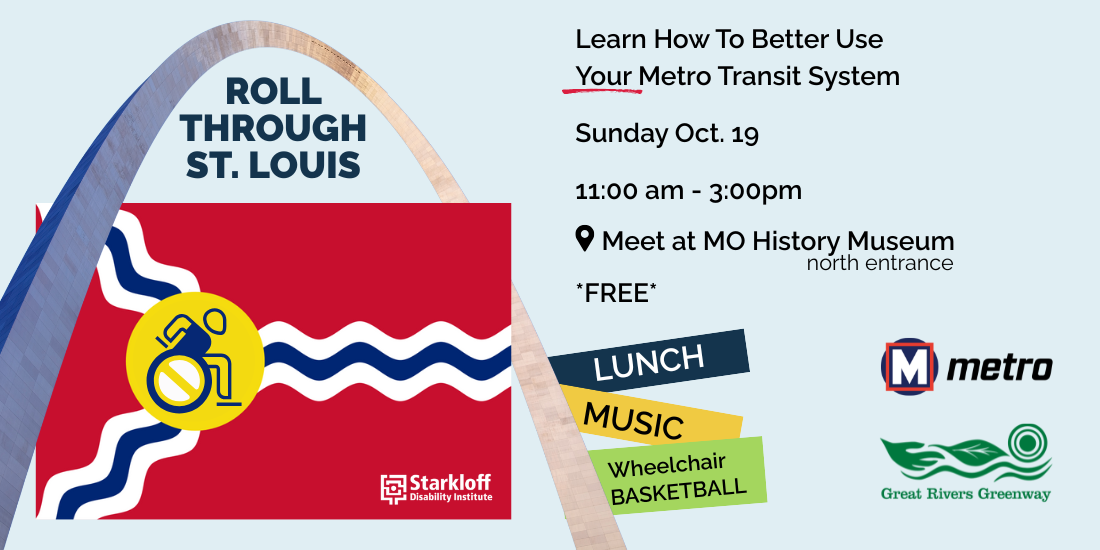
In my role at Starkloff, I reached out to Great Rivers Greenway, Trailnet, and Metro St. Louis. Together we came up with a new event: Roll Through St. Louis.
On a recent Sunday in October, we gathered cyclists, wheelchair users, walkers, and joggers at the Missouri History Museum and made our way up the St. Vincent Greenway that cuts through the historic Central West End. It was a beautiful (although windy), leisurely walk/roll through a little piece of nature in the middle of the city. Our partners shared the history of the area as we passed small parks and sculptures intended to bring the community together.
We ended up almost 2 miles north at Trojan Park where barbecue and live music were waiting for us.
People met and talked with staff from Metro, Great Rivers Greenway, and Starkloff, learning more about the region’s growing greenway network, other shortcuts, and the basics of public transportation. Metro helped attendees download its scheduling/trip planning/bus locating mobile app.
This event was brought folks together to eat, drink, meet each other, share favorite routes through the city, and, most importantly, to come together and begin to create a community.
Build your Disability Confidence with us.
I am looking forward to the spring and creating more events and opportunities to get people with and without mobility disabilities rolling through St. Louis.
If you have a favorite walk or roll through St. Louis, let me know.