Disability Led: Transitioning from High School to College as a Student with a Disability
By: Danielle Guiffrida, MSW • Dream Big Coordinator
Starkloff Disability Institute is proud to be a disability-led organization. It is so fundamental to our philosophy that it is included in our mission statement. Our programs are led by people with disabilities themselves. We have the lived experience. We’ve been in our candidates’ shoes. We get it. Our Disability Led posts are lived experiences shared by a member of our team.
I was born about a month early, and when I arrived, doctors could tell right away that I had some form of physical disability. Later it was later diagnosed as cerebral palsy. During my early childhood, I received a lot of physical and occupational therapy before entering school. My parents didn't notice any major concerns with my ability to learn, so they enrolled me in the same parochial school my older sister attended.
By first grade, my parents began noticing that I was struggling to recall information I was learning in the classroom. Throughout my elementary school years, they searched for the right educational setting for me. During this quest, I attended three different schools before my parents decided to enroll me in the public school system.
In public school, I received additional academic supports that allowed me to attend self-contained classes for my core subjects while spending time with my non-disabled peers during homeroom and elective classes.
I started attending my own IEP (Individualized Education Program) meetings in sixth grade, sharing my opinions about what I liked about school.
At that age, I never really thought about what I wanted to be when I grew up. No one at school or at home asked me what I wanted to do after graduation—it simply wasn't part of the conversation.
Planning for Transition
During my 10th-grade IEP meeting, my school team began discussing my transition out of secondary education.
In my school district, students in special education could participate in a work study program during their junior and senior years of high school. I vividly remember the conversation between my mom and my IEP case manager about this program. They agreed that the special education work study program might not be a good fit for me—it seemed like I would be bored with that kind of work.
My case manager suggested another program available to all juniors at my school. It involved working at a local grocery store chain and taking business classes. My mom and I agreed that this sounded like a better fit.
Looking back now, I realize that my case manager probably suggested it because it resembled supported employment. She probably expected the same thing many other nondisabled adults do: that my education would end after I graduated high school (and no longer required to be in school by law), my path went straight to the workforce. In this case there wouldn't be much need to plan for my transition at future IEP meetings.
But little did they know what I would choose for myself.
Paths Diverge
When a student with an IEP turns 16, the IEP team starts planning for life after high school (officially called "transition").
During this process, students are often asked one big question:
"What do you want to do after you graduate high school?"
It's a question that many 16-year-olds—both with and without disabilities—aren't really prepared to answer. But for students with IEPs, that answer shapes the rest of their educational career…so basically their entire future.
Typically, the options presented are:
- Staying in school until age 21 to focus on vocational skills,
- Entering supported employment, or
- Going to college.
Our Expectations Shape Our Futures
At the time, my school system encouraged most students in special education to pursue supported employment. But when I was asked that question about what I wanted after high school, I thought about my older sister who I followed in milestone after milestone. She had just gone to college, so that was my next step, too. I answered, “I want to go to college.”
My IEP team looked at me with hesitation. They wondered how I would be ready for college-level work, especially writing essays and papers, since my classes had always been modified. So, during my senior year, the school switched me to a general education English class.
During my senior year of high school, I received a lot of support from my case manager, especially in learning how to write. Unlike my nondisabled peers who had been practicing for years, no one expected that from me before.
It wasn’t until I attended community college that I truly began to understand grammar and writing more effectively. During that time, I also had to learn to navigate a new education system.
The Rules Change
In grade school and high school, schools are legally required to have those IEP meetings to collaborate with parents and provide the accommodations identified in the plan. Even if a student or family is unfamiliar with the system, the school is responsible for each student receiving disability services to have an IEP.
In postsecondary education, that is no longer the case.
Wherever students with disabilities continue their education—college or trade/tech schools—the student must proactively disclose their disability to receive reasonable accommodations, beginning with finding the right administrative office to do so: campus disability support services.
Once I learned how to access and use my accommodations effectively, I found my rhythm. I went on to graduate from community college, earn my bachelor’s degree in social work, and later my Master of Social Work from Washington University’s prestigious Brown School.
The Difference One Answer Makes
Throughout my undergrad and graduate education, I often thought back to my junior year IEP meeting. When I was asked, “What do you want to do after you graduate high school?” I didn’t really know the answer then. Looking back, I realize how much I’ve accomplished because I chose a path whose outcome was uncertain. I’m grateful I took that chance, because it led me to my dream job: coordinating the Dream Big program at SDI.
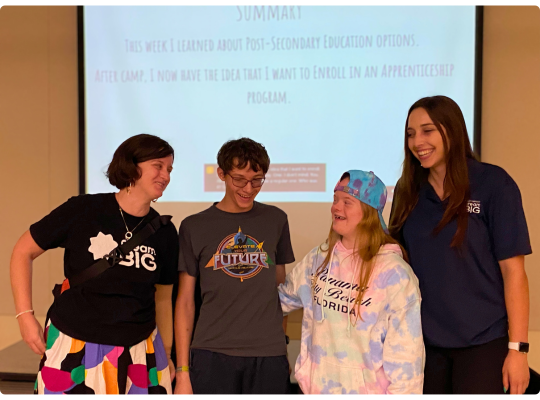
Dream Big is a one-of-a-kind initiative for youth with disabilities to explore high-demand career paths while in middle and high school. Because we are disability-led, we have the experience to understand just how big the stakes at their age. We’ve navigated it ourselves. Our goal is to help students feel prepared to answer that same IEP question—“What do you want to do after you graduate high school?”—with confidence.
By the time these young people leave the program, they understand just how vast the possibilities for their futures are. And that it is up to them to determine and pursue their goals.